ResearchQA: A Citation-Grounded Benchmark for Scientific Paper Question-Answering
A 6,211-question benchmark for single-paper scientific QA, paired with a deterministic citation matcher that discriminates frontier models 4× more sharply than LLM-judge metrics.
Abstract
Large language models increasingly help researchers read scientific literature, but evaluating whether a model cites verifiable evidence remains a structural challenge that standard LLM-as-judge metrics fail to surface. We introduce ResearchQA, a 6,211-question single-paper QA benchmark across 494 open-access papers in eight domains and four question types (lookup, comprehension, multi-hop, adversarial), graded by a deterministic citation matcher alongside an anchored-rubric LLM judge. Two design decisions distinguish ResearchQA: the schema admits multiple valid alternative passages per required citation, and the adversarial slice scores grounded refusal rather than silent refusal — both invisible to embedding-similarity or aggregate judge metrics. Across eight frontier and open-weight LLMs run through a citation-grounded chat-with-paper harness (Open Paper), the deterministic citation metrics discriminate systems ~4× more sharply than the LLM-judge metrics: judge scores compress into a 0.255-point band while section coverage and citation accuracy spread by 14–32 points. Open-weight models on Cerebras reach near-frontier citation accuracy (Zai GLM 4.7: 0.840 vs the best closed score of 0.845) at 3–6× lower per-row latency. The benchmark, the harness, and the judge prompt are released openly.
Introduction
Open Paper is a research-paper reading tool whose differentiating product claim is citation-grounded answers: every model-generated assertion should be traceable to a verifiable passage in the source paper, so that a researcher can check the citation and trust (or distrust) the answer based on evidence rather than the model's confidence. This work builds the benchmark needed to test that claim — concretely, to measure whether Open Paper's chat-with-paper harness delivers grounded answers across model providers, and to do so repeatably enough that prompt and retrieval changes can be evaluated within minutes against a fresh local database. Scope is restricted to single-paper QA; Open Paper's multi-paper pipeline has an agentic evidence-gathering architecture that requires its own benchmark design and is deferred to a follow-up.
Question-answering benchmarks for scientific papers have a longer history than benchmarks for general-purpose RAG systems, but the existing ones either target the wrong corpus, the wrong granularity of evidence, or omit the failure modes that matter most for a citation-grounded product. HotPotQA is grounded in Wikipedia and constructed for multi-hop reasoning; it is well-curated and widely used, but Wikipedia articles lack the dense numerical and methodological content — statistics, tables, methods sections, findings — that a "chat with this paper" feature is constantly asked to ground. We eliminated it for that reason.
The closest fit to our needs is QASPER: a curated corpus of NLP papers with questions, answers, and supporting evidence extracted by human annotators. QASPER's design choices — paper-level scope, evidence-anchored answers, multiple question types — directly inform ours. The two reasons it was not enough on its own are that it covers only NLP papers (we need a domain-diverse corpus to measure a general-purpose research tool), and that its annotation pipeline used paid graduate-student labelers, which conflicted with the scale of the rows-per-paper density we wanted. The open question that motivates a substantial part of this work is whether a strong frontier LLM, paired with a deterministic verification step against the source text, can stand in for human annotators well enough to extend QASPER's design to a multi-domain dataset at low cost.
RAG-evaluation frameworks like RAGAS and ARES sit one level of abstraction away. They measure faithfulness and context relevance over a generic multi-document store, but the signal we care about — did the model cite a real passage from the specific paper it was asked about, and did it cite the right sections of that paper — operates at the granularity of one paper per question, not many. Their faithfulness scores can be reused inside a single-paper benchmark but do not replace the structural evidence-anchoring that QASPER and our work both require.
LLM-as-judge methodology has well-documented failure modes that any benchmark relying on it has to engineer around. The first is rubric collapse: when a 1–5 scale is anchored only at its endpoints ("5 = correct, 1 = wrong"), judges concentrate scores at 5 and lose all discrimination. We observed this directly in our first benchmark run, where every system scored exactly 5.000 on factual accuracy and 5.000 on groundedness. We addressed it by anchoring every level of the scale with concrete criteria. The second is same-family bias: a judge from the same model family as the system under test tends to over-rate it, which becomes a credibility issue if a single judge is used to grade all systems. Methods describes how we mitigate these factors.
Citation evaluation in practice is also harder than it looks: PDF text extraction is noisy enough that a faithfully-quoted citation regularly fails a naive substring check, and the natural alternative (embedding similarity) has the opposite failure mode — it passes fabricated-but-on-topic content that happens to live near real paper text in embedding space. The verbatim-vs-paraphrase tradeoff is structural and forces a deliberate design choice; how we resolve it is described in Methods.
Three measurement needs follow from this background. First, a metric that fails a confident, well-written, but fabricated citation — independent of, and separable from, answer quality; without this, models that prose-glue plausible-sounding numbers score identically to models that quote the paper. Second, adversarial robustness measured directly: when a question contains a false premise, the right behavior is to refuse and explain why, and the benchmark should reward that behavior with a first-class score rather than burying it inside an aggregate judge rating. Third, multi-hop reasoning measured by which sections of the paper are integrated, not just whether the prose mentions multiple things.
Methods
Three design constraints shape the implementation. First, deterministic citation metrics wherever possible — every score should be reproducible without an LLM in the loop, with the judge reserved for what the matcher cannot do. Second, a schema that admits multiple valid evidence passages per required section, since papers contain many phrasings of the same fact. Third, a harness that runs locally against a fresh database without CI dependencies, so that an engineer can iterate on the underlying retrieval pipeline within minutes. The benchmark's three concrete artifacts are the dataset itself, the harness that runs models against it, and the grader that scores their outputs; we describe each in turn, plus the two pieces of grader machinery — the citation matcher and the LLM judge — that account for most of the signal in the results.
Dataset construction
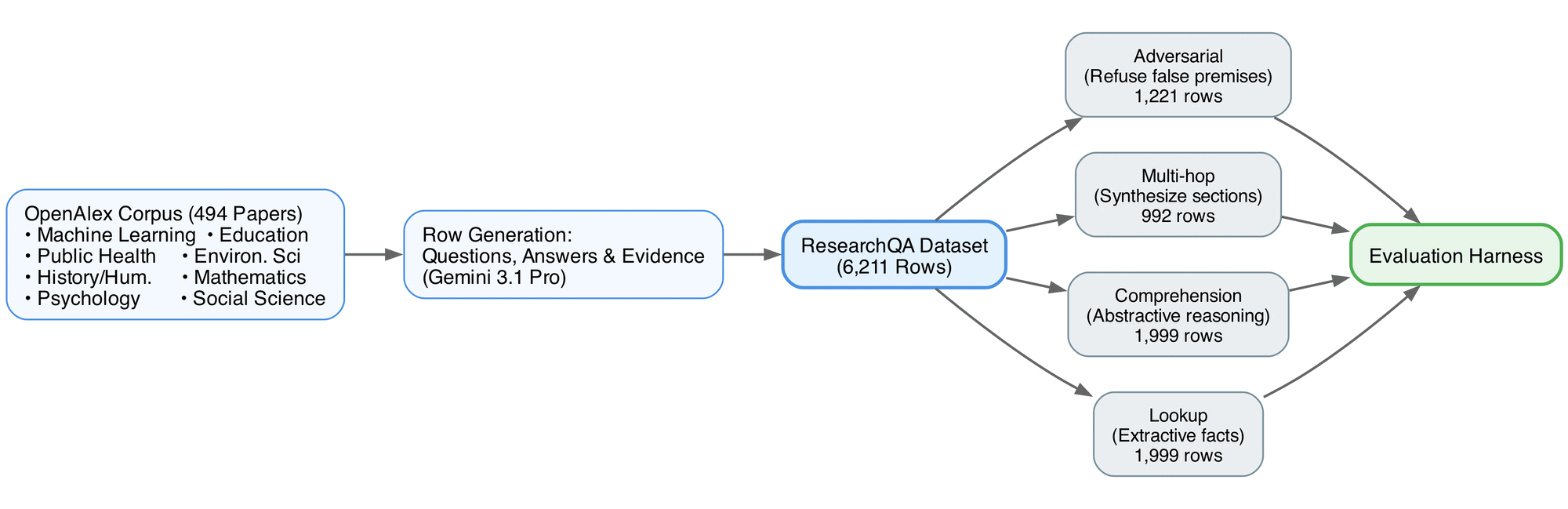
Figure 1: ResearchQA dataset construction pipeline. The corpus is drawn from OpenAlex across 8 domains. Questions and expected citations are generated by Gemini 3.1 Pro before benchmarking via the evaluation harness.
The paper corpus is sourced from OpenAlex's open-access subset across eight domains (machine learning, public health, education, environmental science, history and humanities, mathematics, psychology, and social science), selected to balance technical density (numbers, methods, tables) with prose-heavy disciplines that exercise abstractive comprehension. At the time of this paper, the benchmark contains 494 papers; both the PDF (for the harness's input pipeline) and the extracted full text (for grading-time citation matching) are stored.
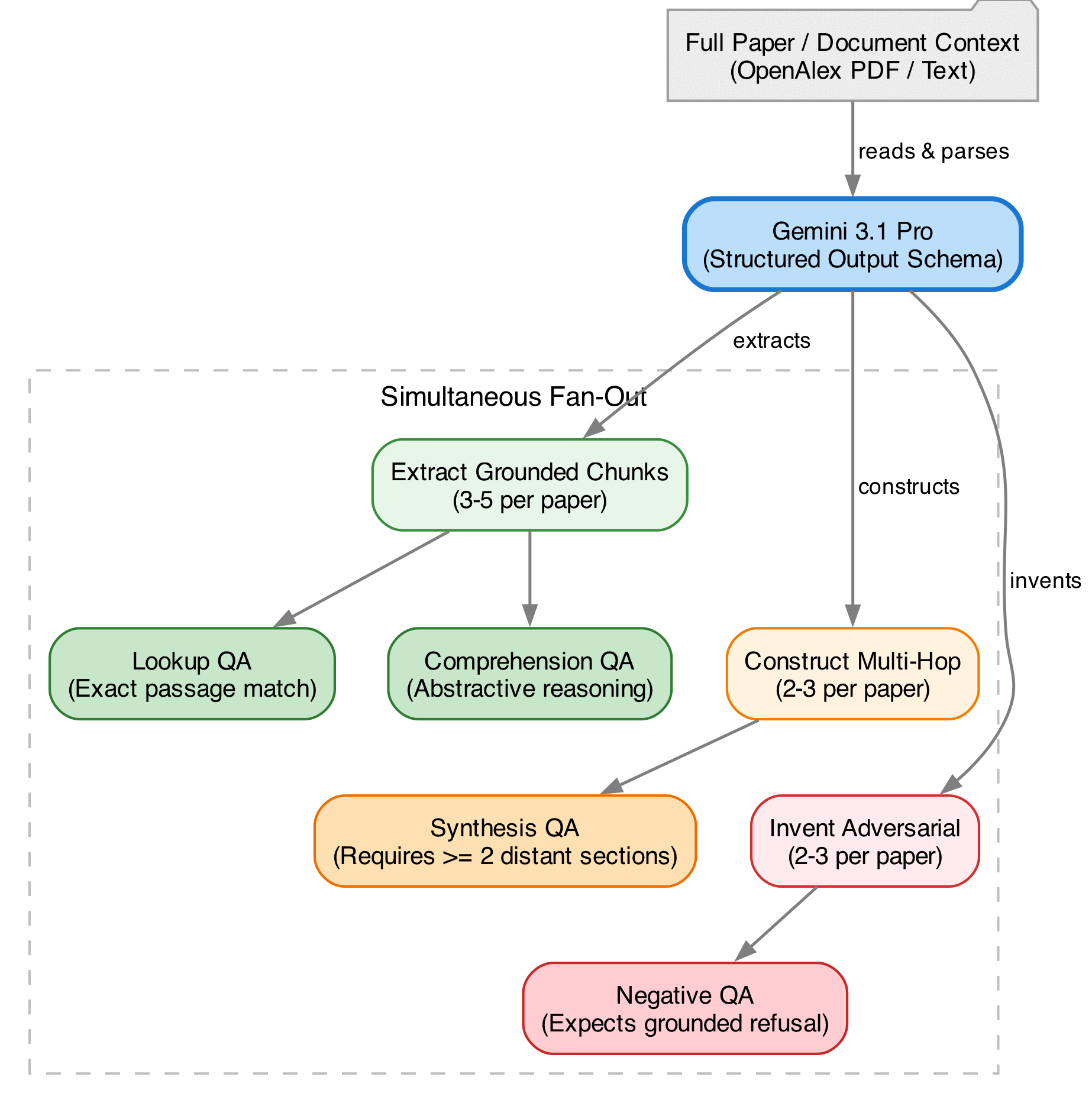
Question/answer/evidence triples are generated per paper chunk by Gemini 3.1 Pro under a structured-output schema (PaperEvalGeneration) that constrains the model's output shape and validates each row against the schema before it is written.
Figure 2: Row generation fan-out. The agent reads the paper and simultaneously extracts grounded chunks (pairing them with lookup and comprehension questions), constructs multi-hop questions requiring cross-section synthesis, and generates adversarial questions containing false premises.
At the time of writing, the dataset has 6,211 rows: 1,999 lookup, 1,999 comprehension, 992 multi-hop, and 1,221 adversarial. The four-way taxonomy evolved with the benchmark itself. The first iteration used only extractive (lookup) and abstractive (comprehension) questions, following QASPER's design. Frontier models saturated near ceiling on that slice — every model scored above 0.95 on lookup citation matching — so we added multi-hop (which forces synthesis across non-adjacent sections of the paper) and adversarial (false-premise or unanswerable, which forces refusal-with-grounded-evidence rather than a confident fabrication). The four question types are:
lookup(extractive): a factual question whose answer is a single passage in the paper — e.g. "what was the sample size?" — testing whether the model can locate and quote the right span.comprehension(abstractive): an open-ended question about themes, methodology, or implications that requires the model to synthesize a passage rather than copy it — e.g. "what is the authors' critique of prior work?".multi_hop: a question whose answer cannot be obtained from any single passage and requires combining evidence from two or more distant sections — e.g. comparing a result against a stated baseline, or computing a derived quantity from numbers spread across methods, results, and tables.adversarial: a question containing a false premise or asking about something the paper does not address — e.g. asking about a placebo arm in a single-arm study — where the correct behavior is to identify the false premise and refuse rather than fabricate an answer.
Multi-hop questions are the hardest of the four to generate well, since the LLM-author must construct a question whose answer cannot be obtained from any single passage of the paper. The structured-output schema enforces this at generation time. Each multi-hop row must carry at least two distinct verifiable blocks of evidence fitting the SectionEvidence schema. Each block points to a different section of the paper, with verbatim alternatives drawn only from that section. The schema also requires a one-sentence reasoning_chain field that names the dependency between the hops (for example, "Methods reports n=240; Table 3 reports effect=0.4; Discussion notes uncontrolled confounder X — combine to assess effective power"), and an explicit judge_rubric criterion that the answer must integrate information from each required section, which prevents the LLM judge from awarding full credit to a fluent answer that addresses only one hop. In practice the most common multi-hop patterns the generator produces are: comparing a result to a stated baseline, checking whether a discussion caveat invalidates a headline claim, and computing a derived quantity from numbers spread across methods, results, and tables.
Based on the evidence blocks, scoring uses AND across sections, OR within each section's alternatives: a model satisfies a row when it cites at least one alternative from every required section. For lookup and comprehension rows this typically resolves to a single SectionEvidence with multiple alternatives, so coverage is binary. For multi-hop rows the list contains one SectionEvidence per required section, so coverage is fractional — a model that addresses two of three required sections gets 0.667 credit.
Construction tradeoffs
Three deliberate decisions are worth recording, since each shapes how the results should be read.
- No human annotators in v1. We considered working with a cohort of graduate-student labelers to validate a subset. We deferred this: the LLM-generated dataset plus the deterministic citation matcher gives us a usable signal without it, thought the absence of human labels is recorded explicitly as a limitation. A future labeler-augmented subset would let us report inter-annotator agreement and calibrate the LLM judge against human scores.
- Public release on HuggingFace, not private hold-out. We discussed whether to keep the dataset private to minimize test leakage into future model training. We chose public release (
khoj-ai/ResearchQA) to make the benchmark useful to the community; we accept that future model versions may have seen some of these papers and questions during training, and treat that as an unavoidable cost of an open benchmark. - No reference-based n-gram metrics (ROUGE, BERTScore). We considered using these measurements as calibration alongside the LLM judge. We dropped them — they reward surface overlap with the expected answer rather than the citation-grounded faithfulness we actually care about, and adding them would have diluted the signal of the metrics we kept.
Benchmark harness
The harness routes each question through Open Paper's full chat-with-paper pipeline — retrieval over the indexed paper, the citation contract that requires the model to anchor each claim to a quoted passage, and the structured-output parser that extracts citations from the model's response. Execution is async-batched per provider (default batch size 5), with a default of 100 evenly-spaced rows from the full 6,211-row dataset for fast iteration and a an optional flag for the complete run. Results are written incrementally to a json file after each batch.
Metrics
Each row is scored on up to six metrics, four deterministic and two LLM-judged.
The four deterministic metrics are:
- citation precision: the fraction of the model's citations that match some alternative in some required section — measuring how many of the model's citations were "useful" for the rubric.
- section coverage: the fractional satisfaction of required sections, AND across sections and OR within each section's alternatives — measuring whether the model touched every required section.
- citation accuracy: the fraction of the model's citations that are verifiable substrings of the paper's raw text, after the normalization pass described below — measuring whether the model fabricated quotes.
- refusal correctness (adversarial rows only): 1.0 if the model refused entirely or every citation it produced is grounded in the paper, 0.0 if any cited passage is fabricated — measuring whether the model invented evidence to support its refutation of a false premise.
The two LLM-judged metrics, each on a 1–5 scale with per-level anchored definitions described below, are:
factual_accuracy: whether every factual claim in the answer is consistent with the expected answer.completeness: whether every key point in the expected answer is addressed.
We deliberately measure the deterministic and judge metrics independently so that the citation-grounding signal cannot be drowned out by judge noise; this separation also makes the judge's failure modes visible (when the deterministic metrics show wide variance and the judge metrics saturate, we know to look at the judge).
PDF-aware citation matcher
The citation matcher decides whether a model's quoted citation appears in the paper's extracted text. Naively, this is a substring check; in practice, PyPDF2's text extraction introduces enough noise — line-break hyphenation preserved as -\n, stray mid-word spaces, ligatures, smart quotes — that a faithfully-quoted citation regularly fails an exact match. The matcher absorbs this noise through a normalization pipeline applied to both the citation and the paper text: lowercase, Unicode NFKD decomposition followed by a translation table (smart quotes → straight, ligatures → ASCII components, en/em dashes → hyphen), and whitespace collapse. Wrapping quote and punctuation characters are stripped from the citation's edges. The matcher then attempts a substring match in three escalating forms: the full normalized citation, an 80-character prefix of it (since LLMs frequently append context past what is verbatim in the paper), and finally a whitespace-stripped form that also collapses end-of-line hyphenation (-\s+ → ""). The third form is what reclaims citations broken by mid-word PDF artifacts. We measured the impact directly: enabling these fallbacks on the existing 100-row Gemini run lifted citation accuracy from 0.554 to 0.817 with no change to model behavior — a 26-point gain that is purely about not under-counting correct citations. We chose this approach over embedding similarity because the failure modes diverge: a normalization-based matcher rejects fabricated content that does not appear in the paper, while an embedding matcher would pass a fabricated-but-on-topic quote that lives near real paper content in embedding space.
LLM judge
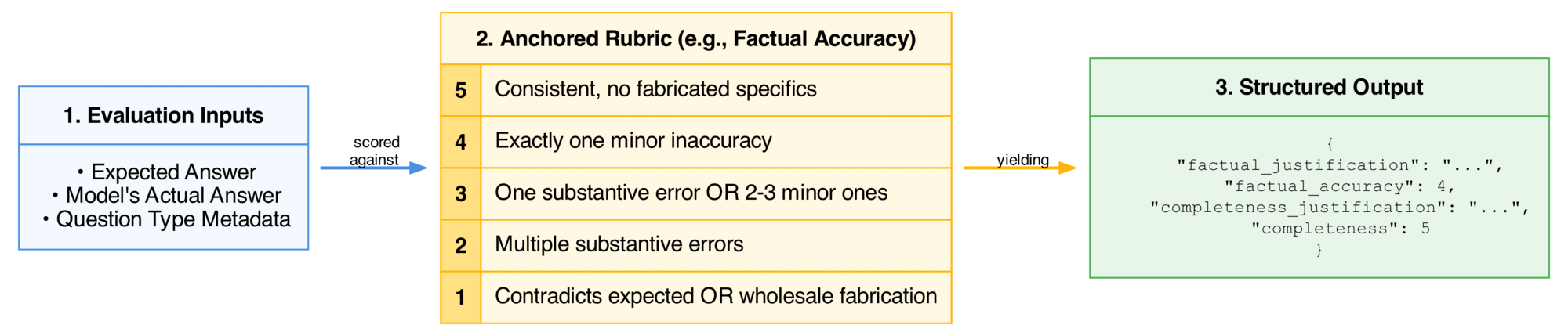
The LLM judge scores factual_accuracy and completeness on a 1–5 scale, with each level anchored by concrete criteria rather than only the endpoints.
For factual_accuracy:
- 5 — every factual claim in the actual answer is consistent with the expected answer with no fabricated specifics.
- 4 — exactly one minor inaccuracy (a misstated number close to correct, a slightly wrong attribution).
- 3 — one substantive error or two-to-three minor ones.
- 2 — multiple substantive errors, or one error that undermines the main claim.
- 1 — the core claim contradicts the expected answer, or the answer is fabricated wholesale.
For completeness:
- 5 — every key point in the expected answer is addressed.
- 4 — exactly one minor omission.
- 3 — one substantive omission or two-to-three minor ones.
- 2 — multiple substantive omissions.
- 1 — the core point is not addressed at all.
Two question-type-specific guidances are added: for adversarial rows, any confident answer that does not flag the false premise scores 1 on factual_accuracy regardless of fluency; for multi-hop rows, addressing only one section when several were required forces a low completeness. The judge is required to cite specific claims or omissions in its justification — vague justifications ("looks accurate", "covers the main points") are explicitly disallowed in the prompt. We saw the per-level anchoring matter directly: under the original endpoints-only rubric, Gemini Pro scored 5.000 on factual_accuracy and 5.000 on groundedness across all 100 rows; under the anchored rubric, completeness picked up genuine variance and the judge began producing justifications that cited the specific point omitted. Even with the anchored rubric, factual_accuracy saturated at 5.000 for Gemini Pro on this slice — interpretable as "the model is genuinely accurate on the factual claims this dataset asks about" rather than as residual rubric collapse, since weaker models in the comparison did receive sub-5 scores. Currently a single Gemini judge grades all systems including itself; same-family bias is a known limitation discussed in the Appendix.
Figure 3: LLM judge evaluation flow. The judge operates on a strict 1–5 anchored rubric designed to combat score collapse, and it must output a detailed justification before outputting the final numerical score to enforce a chain-of-thought analysis.
Results
We ran the benchmark end-to-end through the Open Paper chat-with-paper harness against eight LLMs covering four model providers in two configurations each — a more intelligent model and a faster model: gemini-3.1-pro-preview / gemini-3-flash-preview, gpt-5.4 / gpt-4.1, claude-opus-4-7 / claude-haiku-4-5, and the Cerebras-hosted gpt-oss-120b / zai-glm-4.7. Each system answered the same 100-row evenly-spaced sample of the dataset, and each row was graded by the deterministic citation metrics and the LLM judge described in Methods. Aggregate results are shown below, ranked by a composite of citation-grounding and answer-quality scores.
| Model | Cite. Prec | Sect. Cov | Cite. Acc | Refusal | Factual | Compl. | Lat. (s) |
|---|---|---|---|---|---|---|---|
| gemini-3.1-pro-preview | 0.723 | 0.955 | 0.817 | 0.870 | 5.000 | 4.940 | 18.3 |
| gpt-5.4 | 0.647 | 0.902 | 0.834 | 0.783 | 4.970 | 4.870 | 12.3 |
| zai-glm-4.7 | 0.744 | 0.776 | 0.840 | 0.783 | 4.906 | 4.875 | 5.6 |
| gpt-4.1 | 0.776 | 0.755 | 0.786 | 0.870 | 4.910 | 4.730 | 10.9 |
| claude-opus-4-7 | 0.569 | 0.876 | 0.809 | 0.739 | 4.980 | 4.980 | 30.4 |
| claude-haiku-4-5 | 0.716 | 0.843 | 0.845 | 0.739 | 4.802 | 4.659 | 9.8 |
| gemini-3-flash-preview | 0.491 | 0.913 | 0.835 | 0.652 | 4.990 | 4.940 | 14.8 |
| gpt-oss-120b | 0.660 | 0.636 | 0.700 | 0.478 | 4.745 | 4.571 | 2.9 |
Table 1: Aggregate performance of all evaluated models across the OpenPaper benchmark. Models are sorted by a composite of citation-grounding and answer-quality scores. Best scores in each column are bolded.
The citation-grounding metrics discriminate; the judge metrics largely saturate. The largest cross-provider spread sits in refusal_correctness (0.478–0.870, a 39-point gap on a 0–1 scale) and section_coverage (0.636–0.955, a 32-point gap). citation_precision (0.491–0.776, a 28-point gap) and citation_accuracy (0.700–0.845, a 14-point gap) follow. The LLM judge, by contrast, separates the field by far less: factual_accuracy (4.745–5.000, a 0.255-point gap on a 1–5 scale) and completeness (4.571–4.980, a 0.409-point gap). We read this as "frontier-tier models are uniformly correct on the kinds of factual claims the dataset asks about, but they vary substantially in which evidence they choose to cite and whether that evidence is verifiable " — exactly the distinction the citation metrics were designed to expose.
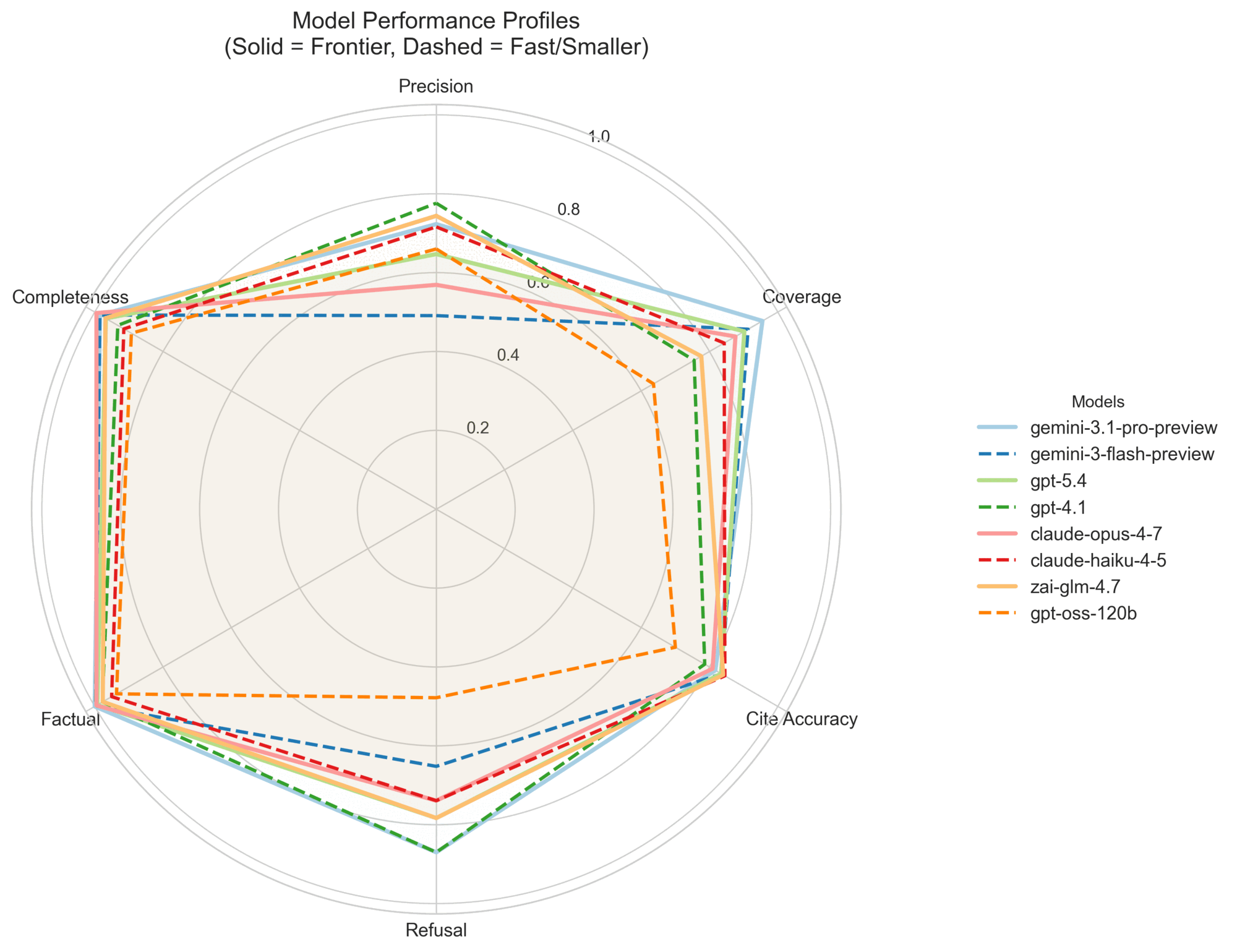
Figure 4: Model Performance Profiles. Frontier models (solid) and their faster counterparts (dashed) plotted across normalized metrics. Judge metrics (Factual, Completeness) are saturated at the perimeter, while strict citation metrics (Precision, Coverage, Refusal) reveal significant differences in model behavior. No single system dominates all dimensions.
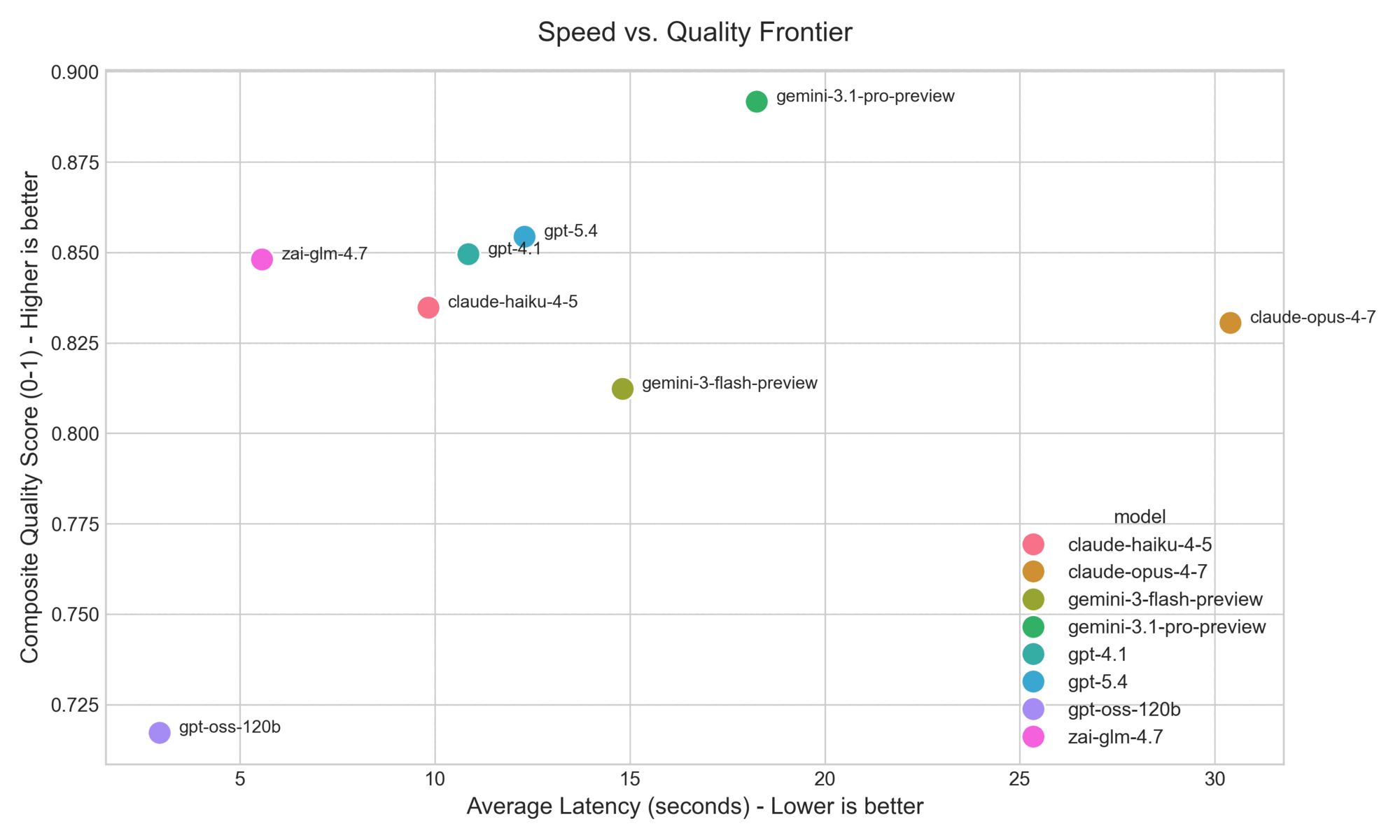
No single system dominates. Gemini Pro leads on composite quality, but four different models top at least one metric in Table 1 — every system is best at something and weakest at something else. Claude Opus 4.7 illustrates the pattern: it ties for the most complete answers but has the lowest citation precision, the signature of a verbose model that finds the right answers and then over-cites. The two Cerebras-hosted models stake out a separate speed-quality frontier: Zai GLM 4.7 reaches near-frontier quality at roughly a third of Gemini Pro's latency, and GPT-OSS-120B is six times faster than Gemini Pro at the cost of meaningful ground on refusal correctness and coverage. The faster variants from the closed-model providers do not form a comparable frontier — they sit in the same latency band as the default models.
Figure 5: Speed-Quality Frontier. Average latency plotted against a composite quality score (average of citation and normalized judge metrics). Fast models like gpt-oss-120b and zai-glm-4.7 establish the low-latency edge, while gemini-3.1-pro-preview leads on quality.
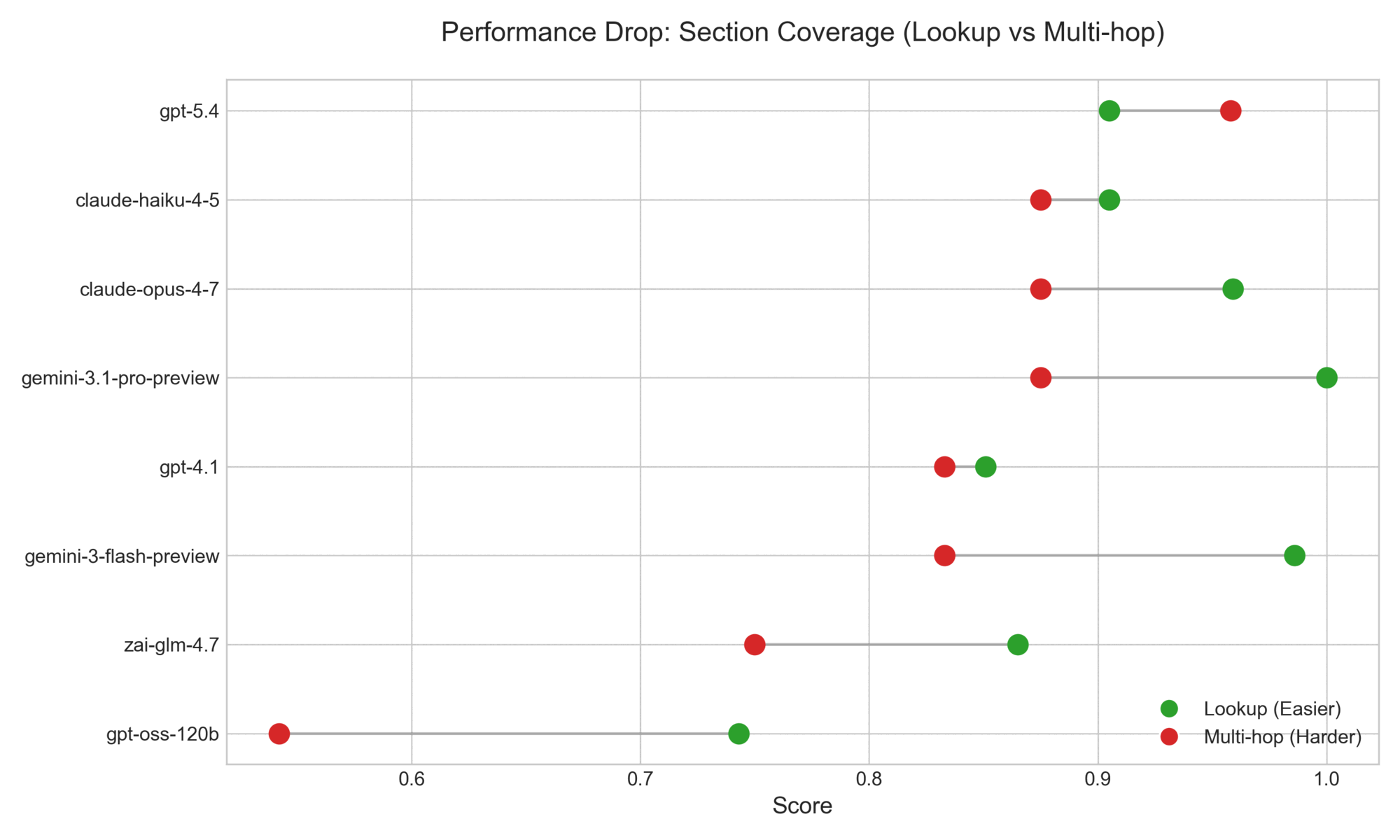
Multi-hop is the consistently hardest slice. Across the eight systems, multi-hop questions show the widest spread on every metric: section_coverage (0.542–0.958, a 42-point gap on a 0–1 scale), citation_accuracy (0.444–0.821, a 38-point gap), factual_accuracy (4.417–5.000, a 0.583-point gap on a 1–5 scale), and completeness (4.000–5.000, a full 1.000-point gap). Lookup and comprehension are partially saturated — every system hits at least 0.703 on lookup citation accuracy, and factual_accuracy on lookup never drops below 4.829 — confirming the original observation from the spec that single-passage retrieval has become an easy slice for current models. The decision to add multi-hop and adversarial categories after observing saturation on the original lookup-only dataset is borne out by the spread numbers: those two categories now drive most of the cross-system signal.
Figure 6: Multi-hop Performance Drop. A comparison of section coverage on lookup versus multi-hop questions. While most models achieve near-perfect coverage on simple lookups (green), performance degrades and spreads significantly on multi-hop questions (red).
Adversarial behavior splits the field cleanly. On adversarial questions, the model is asked something whose premise is false or whose answer is not in the paper. The correct response is to identify the false premise and either refuse or refute with grounded evidence. The new refusal_correctness metric — which marks a row correct when every cited passage is verifiable in the paper text (i.e., the model didn't fabricate evidence to support its refutation) — produces the largest cross-provider gap of any metric: Gemini Pro and GPT-4.1 score 0.870, the next tier (GPT-5.4, Zai GLM 4.7) scores 0.783, the Claude pair scores 0.739, Gemini Flash scores 0.652, and GPT-OSS-120B scores 0.478. The judge's factual_accuracy on adversarial spans 4.478–5.000, a similar shape to refusal but compressed into the top of the scale; the deterministic refusal metric gives a more readable signal.
Latency varies by an order of magnitude. End-to-end per-row latency ranges from 2.9 s (GPT-OSS-120B) to 30.4 s (Claude Opus 4.7). Six of the eight models run under 15 seconds per row; only the two largest reasoning models — Gemini Pro at 18.3 s and Claude Opus 4.7 at 30.4 s — cross that threshold.
Implications for the harness and the benchmark. The deterministic citation metrics are doing the work the LLM judge cannot: they flag when a model fabricates a citation, when it ignores a required section in a multi-hop question, and when it confidently rebuts a false premise with invented evidence. The judge metrics are not useless — completeness does discriminate models, and factual_accuracy would presumably discriminate weaker base models if we added them — but in the current frontier-tier comparison the citation metrics carry most of the signal. Our original intuition that citation grounding is Open Paper's differentiating product claim is precisely what makes these metrics so useful: they measure the differentiator directly.
Performance varies significantly by subject matter. Across the 100-question sample, difficulty is not uniform. Aggregating the strict citation metrics (Precision, Coverage, Accuracy, Refusal) reveals a clear gradient of domain difficulty. Models perform relatively well and consistently on topics like Economics and History/Humanities. Conversely, Education and Machine Learning proved to be the most challenging domains, exhibiting the lowest median scores and the widest variance across models. Intermediate domains like Psychology maintain a relatively strong median, while Biology shows a notable spread of lower-performing outliers despite a decent median.
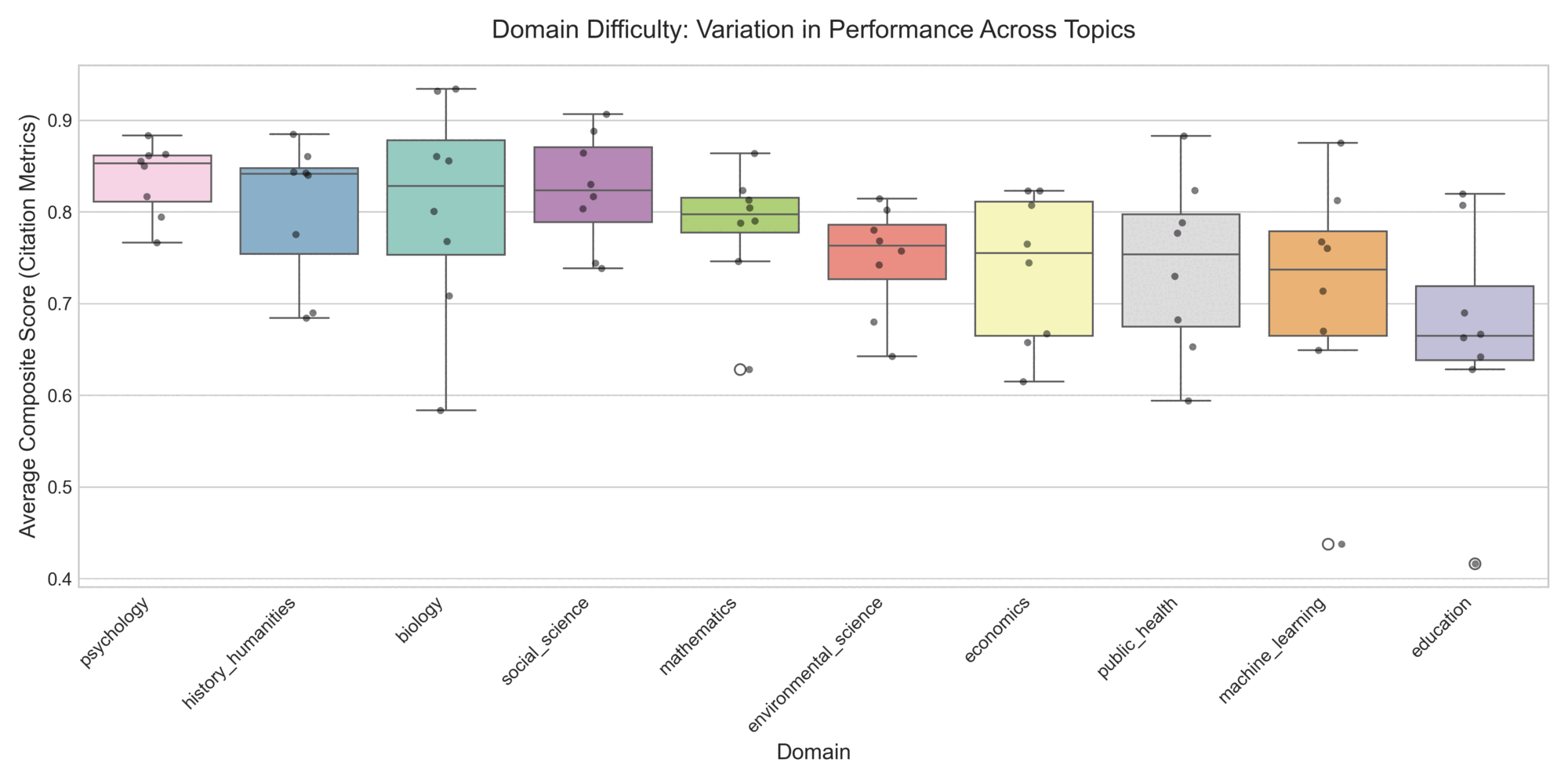
Figure 7: Domain Difficulty Variation. The domains ordered from highest to lowest median performance on the strict citation metrics. Black dots represent individual model scores, illustrating the lower medians and widening spreads on domains like Machine Learning and Education.
Related Work
ResearchQA sits at the intersection of three lines of prior work: scientific paper question-answering, citation-grounded language modeling, and the broader move toward benchmarks that measure end-to-end practical task performance. We summarize each line here and locate our contribution within it.
Scientific paper QA. The most direct ancestor of this work is QASPER (Dasigi et al., 2021), a 5,049-question dataset over NLP papers with human-annotated supporting evidence and a four-way question taxonomy. We discussed QASPER's design influence on ours in Introduction; the differences are scope (we cover eight domains rather than NLP only), annotation pipeline (LLM-generated and matcher-verified rather than human-labeled), and metric set (we add deterministic citation matching and an adversarial-refusal slice).
ELI5 (Fan et al., 2019) takes the opposite design choice on a related axis: long-form, open-ended answers rather than evidence-anchored ones. ELI5 remains a useful benchmark for free-form generation quality, but it does not exercise the citation-grounding behavior our harness is designed around, and was not a candidate for replacing QASPER as our starting point. ScienceQA (Lu et al., 2022) is in the "scientific QA" family by name but at a different granularity — its 21k multimodal multiple-choice questions cover K–12 science topics with image+text inputs and a fixed answer set, rather than free-form generation against a single research paper. Our questions ask the model to read and ground claims in a specific paper; ScienceQA's ask the model to select among options drawn from textbook science. Useful as a complementary benchmark for chain-of-thought reasoning, not a replacement.
Multi-hop and long-document QA. Reasoning over scientific papers is closer to the long-document QA literature than to web-style multi-hop benchmarks. Liu et al. (2024) characterize the "lost in the middle" effect — language models systematically lose information from the middle of long contexts — which is the failure mode our multi_hop slice is designed to surface and our section_coverage metric penalizes. Adjacent work in the area includes long-context multi-document QA benchmarks (Wang et al., 2024a), discourse-structure-aware retrieval (Nair et al., 2023), and iterative or graph-based retrieval methods (Jiang et al., 2025; Wang et al., 2024b) — candidate strategies for the harness's retrieval layer rather than benchmarks we compare against.
Citation-grounded answering. The most direct prior work on the behavior our benchmark measures is GopherCite (Menick et al., 2022), which trains a language model to support its answers with verified verbatim quotes. The metric we call citation_accuracy — does the cited string actually appear in the source — is exactly the verification step GopherCite trains models to perform; our contribution is not a new training method but a measurement infrastructure that grades any model's citation behavior, including models not trained explicitly for it. The verbatim-vs-paraphrase tradeoff we identify in Introduction is also discussed in the GopherCite work, which lands on the same side we do: verbatim is the right contract for groundedness even though it sometimes punishes faithful paraphrase.
Benchmarks for real-world task performance. ResearchQA is part of a broader recent trend in benchmark design that measures models on practical, economically or intellectually meaningful tasks rather than on synthetic puzzles. GDPval (Patwardhan et al., 2025) evaluates models on 1,320 real work products across 44 occupations spanning the top nine sectors of U.S. GDP. The AI Productivity Index APEX (Vidgen et al., 2025) measures professional-task performance in investment banking, management consulting, law, and primary care. The Remote Labor Index (Mazeika et al., 2025) evaluates end-to-end agent performance on real remote-work projects across game development, product design, architecture, data analysis, and video animation. SWE-FFICIENCY (Ma et al., 2025) measures repository-level performance optimization on real software workloads from numpy, pandas, and similar projects. We view ResearchQA as the equivalent for one specific kind of intellectual labor — reading, citing, and reasoning over research papers — and the citation-grounding focus of our metrics reflects what makes that labor worth automating in the first place: a researcher's time is best spent reading evidence, not verifying that the model invented it.
Limitations & Future Work
The most important limitation of v1 is the absence of human-annotated ground truth. The dataset's questions, expected answers, and evidence passages are LLM-generated and verified only by the citation matcher and the LLM judge during benchmarking; our team has spot-checked individual rows during development, but no stratified subset has been independently validated. We would like to recruit domain-expert labelers — graduate students or postdocs with literature-review experience in each represented field — to validate a stratified sample, report inter-annotator agreement, and calibrate the LLM judge against human scores. Until that work happens, every metric in this paper rests on the assumption that Gemini 3.1 Pro's question generation and our matcher's verdicts agree with what an expert human reader would say; we believe this assumption holds for most rows but cannot prove it.
All LLM-judge scores reported here come from a single Gemini model grading every system, including itself. Same-family bias is a documented effect, and the close-to-ceiling factual-accuracy scores for the Gemini-family systems in Results should be read with that in mind. A future release will use either a heterogeneous judge (Deepseek grading Gemini, GPT grading Claude, and so on) or a multi-judge consensus to remove this confound.
The same team that designed the metrics, wrote the matcher, and tuned the rubric also generated and curated the dataset. This collapses several roles that in larger benchmark efforts are kept separate, and choices that improve our reported scores are difficult to distinguish from choices that improve measurement quality. The Construction tradeoffs and Appendix A: Alternatives considered sections record the decisions most likely to be contested; readers should treat the metric/dataset co-design as a known confound.
Every question in the dataset was authored by Gemini 3.1 Pro under a structured-output schema. The dataset's question style, difficulty distribution, and category boundaries therefore reflect one model family's choices about what counts as a "lookup" or "comprehension" or "multi-hop" question. Models from the same family may have a small advantage on this distribution that does not generalize to questions written by humans or by a different LLM family. Diversifying the generator across model families is straightforward and worth doing in a future release.
The corpus and all questions are English-language. ResearchQA's results should not be read as evidence about model behavior on non-English scientific literature; that gap remains an open problem in the broader benchmarking landscape and one this paper does not address.
The corpus is drawn from OpenAlex's open-access subset across eight domains, which is not a representative sample of all scientific literature. Closed-access papers and venues are absent. Within the included domains, our 494-paper sample was further filtered for PDF availability and successful text extraction, which biases against papers with image-heavy layouts, complex tables, or scanned originals — exactly the papers a citation-grounded reader is most useful for.
The dataset is publicly released on HuggingFace (khoj-ai/ResearchQA), which means future model versions may have seen these papers and questions during training. Benchmarks suffer from contamination over time, and ResearchQA is no exception. We accepted this as the cost of an open benchmark; readers comparing model versions released after the dataset's publication date should treat their scores with appropriate skepticism.
The single-paper scope is intentional but partial. The most natural extension of this work is to apply the same benchmark-generation paradigm — LLM-drafted questions under a structured-output schema, augmentation pass for alternative valid evidence, deterministic citation matching against source text, adversarial slice scored on grounded refusal, per-level anchored LLM judge — to multi-paper QA, where the system must gather evidence across multiple documents to answer a single question. Open Paper's multi-paper pipeline has an agentic evidence-gathering architecture that the current schema does not capture; the SectionEvidence structure would generalize to (paper_id, section_label, alternatives) triples, and the matcher already operates per-paper. The harder design question is how to score the retrieval step itself when the right set of supporting documents is not pre-enumerable, which is exactly what makes the multi-paper benchmark a separate piece of work rather than a straightforward extension. We expect to release a multi-paper companion benchmark in a follow-up.
Appendix A: Alternatives considered
This appendix records the design alternatives we considered and rejected, organized by which piece of the benchmark they would have replaced. The intent is to make the reasoning behind the current design auditable: every choice in the main text has at least one credible alternative, and most of the rejections were observed empirically rather than chosen on first principles.
Schema alternatives
The first iteration of expected_references was a flat list[str] of supporting passages. It worked for single-section lookup questions but could not express "the answer must touch sections A and B" without conflating the two requirements into a single bag of strings; we replaced it with the current SectionEvidence structure when we added multi-hop questions and discovered that the matcher had no way to distinguish "missed an entire required section" from "cited the right section but a different valid alternative within it." A single-canonical-reference design — closer to QASPER and easier to author — was rejected for the opposite reason: we observed the model regularly citing thorough, grounded passages that differed from the dataset's chosen one, and a single-canonical schema would have scored those as wrong. Free-text grounding (no structured references at all, just an LLM judge looking at the prose) was rejected because the judge is not a reliable groundedness signal without the source paper in its prompt — which we measured directly when our LLM-judged groundedness score collapsed to 5.000 across all systems.
Metric alternatives
The original metric set included citation_recall (the fraction of expected references the model matched), which we replaced with section_coverage because recall conflates "missed a required hop" with "cited one of three valid alternatives within a hop" — both produce a less-than-perfect recall, but they describe completely different failure modes. Section coverage is structurally aware: the AND-across-sections, OR-within-alternatives semantics maps directly to the question structure rather than counting matches in a flat list. The original adversarial metric was strict in a different way: it required the model to cite only passages from a pre-listed refutation set, which severely under-scored correct refusals that cited additional grounded supporting evidence the dataset could not exhaustively pre-enumerate. Replacing it with "all cited passages are grounded in the paper text" (using the same matcher as citation_accuracy) lifted refusal correctness by roughly 65 points across providers without changing model behavior — the entire gap was in the metric, not in the systems being measured. We also removed LLM-judged groundedness from the judge dimensions for the reason described above; a paper-text-augmented judge could in principle outperform the deterministic matcher on paraphrased citations, but at significant token cost and with weaker reproducibility guarantees, and we preferred to delegate groundedness to the matcher. Finally, we considered a semantic-similarity citation matcher (embedding cosine over the model's quote and the paper text) and rejected it for the citation_accuracy metric specifically: we want to fail fabrication, and an embedding match between a fabricated-but-on-topic quote and the paper would pass. The harness-side citation contract demands verbatim quotation; the matcher should enforce it.
Judge alternatives
The current judge is a single Gemini model grading all systems including itself, which is the cheapest configuration and the one most vulnerable to same-family bias. A cross-family judge (Claude grading Gemini and OpenAI, Gemini grading Claude, and so on) would mitigate that bias but multiplies grading cost and adds a normalization step across judges with different scoring tendencies; we have flagged this as an open item for the next release. A multi-judge consensus (mean of three different judges per row) would give a stronger signal still, at roughly 3× cost and with harder-to-debug score disputes. A more interesting alternative — and a candidate for a v2 judge if factual_accuracy continues to saturate as we add weaker base models — is enumeration-then-score judging: a two-pass design in which the judge first enumerates each factual claim in the actual answer and marks each verified, unverified, or contradicted, and the 1–5 score is derived deterministically from those counts. This would remove the judge's subjective number-picking entirely and yield a much more discriminating signal at the cost of a second LLM call per row. The fourth alternative considered was paper-text-in-prompt judging: pass the full paper or a relevant excerpt to the judge so it can verify groundedness independently of the matcher. We rejected this for cost (papers run to 200 KB of text, which multiplies across rows and models) and because LLM judges tend to over-credit plausible-sounding paraphrases even when given the source text — the matcher is a stricter and cheaper check.
Question-generation alternatives
The gold standard for question quality is human authorship, which we deferred for cost reasons (we originally budgeted for graduate-student labelers; we chose to skip the labeled subset in v1 and accept the resulting limitation). The current pipeline uses Gemini 3.1 Pro to draft and augment questions under a structured-output schema, with the citation matcher and the LLM judge surfacing mistakes during benchmarking — a compromise that gives us scale without human validation but ties the dataset's distribution to one model family's question-writing style. The original pipeline used a single-pass generation step that produced refutation sets too thin (often a single alternative, or none) for the adversarial metric to work. The current pipeline folds an augmentation step into the default generation flow, widening each SectionEvidence with additional valid alternatives from the same section. That widening is what made the new adversarial scoring viable — without it, the metric would have continued to penalize correct refusals for citing legitimate-but-unenumerated supporting passages.
Harness-vs-baseline comparison
The harness ships a --baseline mode that bypasses the OpenPaper retrieval and citation contract entirely, sending the question and the raw PDF directly to the LLM. In principle, the side-by-side comparison of harness mode against baseline mode for the same model isolates the contribution of the harness from the contribution of the underlying LLM, and was originally intended to be the central comparison the benchmark answers. We ran early pilots in baseline mode and observed that on the answer-quality metrics (factual_accuracy, completeness) the gap between harness and baseline was small for frontier models — the underlying LLM was already strong enough that adding retrieval and citation-contract scaffolding did not meaningfully change response correctness. Given that the deterministic citation metrics by design cannot be evaluated in baseline mode (baseline outputs are free-form prose without a structured citation contract), and that running the full eight-model baseline sweep would roughly double per-row inference and grading cost without producing comparable citation-grounding signal, we elected to omit the baseline comparison from the headline results. The mode remains in the harness for future use; a more interesting comparison once we add weaker base models, or once we want to specifically argue for the value of the retrieval layer on long-context-limited models, is to selectively re-run baseline on a subset of providers where the harness contribution is most likely to bind.
Appendix B: Code
The dataset's structured-output schema is defined as a hierarchy of Pydantic models in evals/generate_dataset.py. The top-level PaperEvalGeneration is what Gemini 3.1 Pro is asked to produce per paper; the Field descriptions double as part of the prompt, since the structured-output API surfaces them to the model. The full hierarchy is reproduced below in dependency order.
Three sparse per-type fields carry additional grading context: metadata_required_sections annotates the integration target on multi-hop rows, metadata_false_premise and expected_refusal annotate the failure mode on adversarial rows, and judge_rubric carries a per-question rubric that the LLM judge consults when scoring comprehension answers.
class SectionEvidence(BaseModel):
"""Evidence from one section/area of a paper.
A question may require evidence from multiple sections (multi-hop) or just
one (lookup/comprehension). Within a section, the alternatives list holds
multiple verbatim quotes that each independently support the answer — the
model only needs to cite ONE of them to satisfy that section.
"""
section_label: str = Field(
description="The section/area the evidence comes from, e.g. 'Methods', "
"'Results', 'Table 3', 'Discussion'"
)
alternatives: list[str] = Field(
description=(
"2-3 verbatim quotes from this section that EACH INDEPENDENTLY support "
"the answer. Each must be character-for-character from the paper, "
"50-200 words, and substantively distinct (different passages, not "
"paraphrases of each other). If only one valid passage exists, return "
"a single-element list — never fabricate."
)
)
class LookupQuestion(BaseModel):
question: str = Field(
description="A factual question answerable by finding an exact passage "
"in the paper"
)
expected_answer: str = Field(
description="The correct answer, based on the paper's content"
)
expected_references: list[SectionEvidence] = Field(
description=(
"Exactly ONE SectionEvidence covering the section that contains the "
"answer, with 2-3 alternative verbatim quotes inside."
)
)
class ComprehensionQuestion(BaseModel):
question: str = Field(
description="An abstractive question about themes, methodology, "
"implications, or critique"
)
expected_answer: str = Field(
description="A well-reasoned answer drawing on the paper's content"
)
expected_references: list[SectionEvidence] = Field(
description=(
"1-2 SectionEvidence objects covering the section(s) that support the "
"answer. Each contains 2-3 alternative verbatim quotes."
)
)
judge_rubric: str = Field(
description="3-5 evaluation criteria for an LLM judge to score answers "
"on a 1-5 scale"
)
class MultiHopQuestion(BaseModel):
question: str = Field(
description=(
"A question that REQUIRES synthesizing information from >=2 distant "
"sections of the paper. The answer must NOT be obtainable from any "
"single passage. Examples: comparing a result to a stated baseline; "
"checking whether a discussion caveat invalidates a headline claim; "
"computing a derived quantity from numbers spread across methods + "
"results + tables."
)
)
expected_answer: str = Field(
description="Reasoned answer that explicitly combines facts from each "
"required section."
)
expected_references: list[SectionEvidence] = Field(
description=(
"TWO OR MORE SectionEvidence objects, one per required section. The "
"answer must combine evidence from all of them. Within each "
"SectionEvidence, provide 2-3 alternative verbatim quotes from that "
"section — the model only needs to cite ONE alternative per section "
"to satisfy that hop."
)
)
reasoning_chain: str = Field(
description=(
"One-sentence description of how the hops connect, e.g. 'Methods "
"reports n=240; Table 3 reports effect=0.4; Discussion notes "
"uncontrolled confounder X — combine to assess effective power.'"
)
)
judge_rubric: str = Field(
description=(
"3-5 evaluation criteria for an LLM judge (1-5 scale). MUST include "
"an explicit criterion: 'answer integrates information from each "
"required section.'"
)
)
class AdversarialQuestion(BaseModel):
question: str = Field(
description=(
"A question with a FALSE PREMISE about the paper, or asking about "
"something the paper does NOT address. The question must sound "
"plausible — a careless reader would not notice the issue. Examples: "
"ask about a placebo arm when the design is single-arm; ask why "
"authors used Bayesian methods when they used frequentist; ask about "
"a population the paper explicitly excludes; ask about a metric the "
"paper did not report."
)
)
false_premise: str = Field(
description=(
"One sentence stating exactly what is wrong with the question, e.g. "
"'The study has no placebo arm — it is single-arm with historical "
"controls.'"
)
)
expected_answer: str = Field(
description=(
"The correct response: identify the false premise and/or state that "
"the paper does not address the topic. May briefly cite what the "
"paper actually says if it directly refutes the premise."
)
)
expected_refusal: bool = Field(
description=(
"True when the correct behavior is to refuse to fabricate / decline "
"to answer. Set False only if the paper directly addresses the "
"question in an unexpected way (rare). Always provide a value."
),
)
expected_references: list[SectionEvidence] = Field(
description=(
"Usually an empty list. If the paper has a passage that DIRECTLY "
"refutes the false premise, include exactly ONE SectionEvidence "
"containing 1-2 verbatim alternative quotes the model should cite "
"when refusing. Otherwise return []."
),
)
judge_rubric: str = Field(
description=(
"3-5 evaluation criteria. MUST include: 'answer correctly identifies "
"the false premise / refuses to fabricate' and 'no fabricated facts "
"about topics the paper does not address.'"
)
)
class PaperChunk(BaseModel):
section: str = Field(
description="Paper section this chunk comes from, e.g. 'Results', "
"'Methods', 'Discussion'"
)
page_hint: Optional[int] = Field(
default=None,
description="Approximate page number where the chunk appears",
)
description: str = Field(description="Brief description of what this chunk covers")
source_text: str = Field(description="50-300 word excerpt from the paper")
lookup_question: LookupQuestion
comprehension_question: ComprehensionQuestion
class PaperEvalGeneration(BaseModel):
paper_id: str = Field(description="The OpenAlex ID of the paper")
chunks: list[PaperChunk] = Field(
description=(
"3-5 interesting chunks from different sections of the paper. Return "
"[] if Section A was not requested in the prompt."
),
)
multi_hop_questions: list[MultiHopQuestion] = Field(
description=(
"2-3 multi-hop questions requiring synthesis across distinct, distant "
"sections. Return [] if Section B was not requested in the prompt."
),
)
adversarial_questions: list[AdversarialQuestion] = Field(
description=(
"2-3 adversarial questions with false premises or asking about topics "
"the paper does not address. Return [] if Section C was not requested "
"in the prompt."
),
)
The complete benchmark code, including the matcher, the harness, and the LLM judge prompt, is available at the Open Paper repository under server/evals/.
Appendix C: Additional charts
This appendix collects supplementary figures that illuminate per-domain and per-question-type behavior beyond what the main results convey.
Figure 8: Citation precision by model and domain. The heatmap exposes domain-by-model interactions invisible in aggregate scores: some systems are uniformly precise across domains while others swing widely between best- and worst-domain performance.
Figure 9: Citation accuracy on lookup versus multi-hop questions. The companion view to Figure 6: where coverage measures whether the model touched every required section, accuracy measures whether the citations the model produced were verifiable substrings of the paper. Multi-hop accuracy degrades and spreads more than lookup accuracy across systems.
References
- Dasigi, P., Lo, K., Beltagy, I., Cohan, A., Smith, N. A., & Gardner, M. (2021). A Dataset of Information-Seeking Questions and Answers Anchored in Research Papers. NAACL 2021. DOI: 10.18653/v1/2021.naacl-main.365.
- Fan, A., Jernite, Y., Perez, E., Grangier, D., Weston, J., & Auli, M. (2019). ELI5: Long Form Question Answering. ACL 2019. DOI: 10.18653/v1/P19-1346.
- Jiang, Z., Sun, M., Liang, L., & Zhang, Z. (2025). Retrieve, Summarize, Plan: Advancing Multi-hop Question Answering with an Iterative Approach. Companion Proceedings of the ACM on Web Conference (WWW '25). DOI: 10.1145/3701716.3716889.
- Liu, N. F., Lin, K., Hewitt, J., Paranjape, A., Bevilacqua, M., Petroni, F., & Liang, P. (2024). Lost in the Middle: How Language Models Use Long Contexts. Transactions of the Association for Computational Linguistics (TACL). DOI: 10.1162/tacl_a_00638.
- Lu, P., Mishra, S., Xia, T., Qiu, L., Chang, K.-W., Zhu, S.-C., Tafjord, O., Clark, P., & Kalyan, A. (2022). Learn to Explain: Multimodal Reasoning via Thought Chains for Science Question Answering. NeurIPS 2022. DOI: 10.52202/068431-0182.
- Ma, J. J., Hashemi, M., Yazdanbakhsh, A., Swersky, K., Press, O., Li, E., Reddi, V. J., & Ranganathan, P. (2025). SWE-fficiency: Can Language Models Optimize Real-World Repositories on Real Workloads?. arXiv preprint 2511.06090.
- Mazeika, M., Gatti, A., Menghini, C., et al. (2025). Remote Labor Index: Measuring AI Automation of Remote Work. arXiv preprint 2510.26787.
- Menick, J., Trebacz, M., Mikulik, V., Aslanides, J., Song, F., Chadwick, M., Glaese, M., Young, S., Campbell-Gillingham, L., Irving, G., & McAleese, N. (2022). Teaching language models to support answers with verified quotes. arXiv preprint 2203.11147. DOI: 10.48550/arXiv.2203.11147.
- Nair, I., Somasundaran, S., Saha, A., & Bansal, M. (2023). Drilling Down into the Discourse Structure with LLMs for Long Document Question Answering. Findings of EMNLP 2023. DOI: 10.18653/v1/2023.findings-emnlp.972.
- Patwardhan, T., et al. (2025). GDPval: Evaluating AI Model Performance on Real-World Economically Valuable Tasks. arXiv preprint 2510.04374. DOI: 10.70777/si.v2i4.17197.
- Vidgen, B., Fennelly, A., et al. (2025). The AI Productivity Index: APEX-v1-extended. arXiv preprint 2509.25721.
- Wang, M., Chen, L., Cheng, F., Liao, S., Zhang, X., Wu, B., Yu, H., Xu, N., Zhang, L., Luo, R., Li, Y., Yang, M., Huang, F., & Li, Y. (2024a). Leave No Document Behind: Benchmarking Long-Context LLMs with Extended Multi-Doc QA. EMNLP 2024. DOI: 10.18653/v1/2024.emnlp-main.322.
- Wang, Y., Lipka, N., Rossi, R. A., Siu, A., Zhang, R., & Derr, T. (2024b). Knowledge Graph Prompting for Multi-Document Question Answering. AAAI 2024. DOI: 10.1609/aaai.v38i17.29889.