 Open Paper
Data Tables: From Reading to Writing
Turn scattered insights across multiple papers into structured, citable tables that bridge the gap between understanding and creating.
Research has a costly handoff problem. You spend hours reading papers, highlighting key findings, noting important numbers, and tracking experimental details. Then when it's time to write, you're left scavenging through a mess of highlights, notes, and memory fragments trying to reconstruct the evidence you need.
What if the insights you extracted from papers could travel with you, intact and citable, from reading to writing?
The Evidence Loss Problem
Every researcher knows this scenario: you've read fifteen papers on similar methodologies, each with slightly different parameters, sample sizes, or outcomes. When writing your literature review, you find yourself:
- Flipping through PDFs trying to find that one statistic you remember
- Recreating tables from scratch based on fuzzy recollections
- Losing perfect quotes because they weren't properly captured
- Spending more time hunting for evidence than analyzing it
This isn't just inefficient—it's costly. The mental overhead of constantly switching between "finding evidence" and "synthesizing ideas" breaks the flow of deep thinking that research requires.
Data Tables: Evidence That Travels
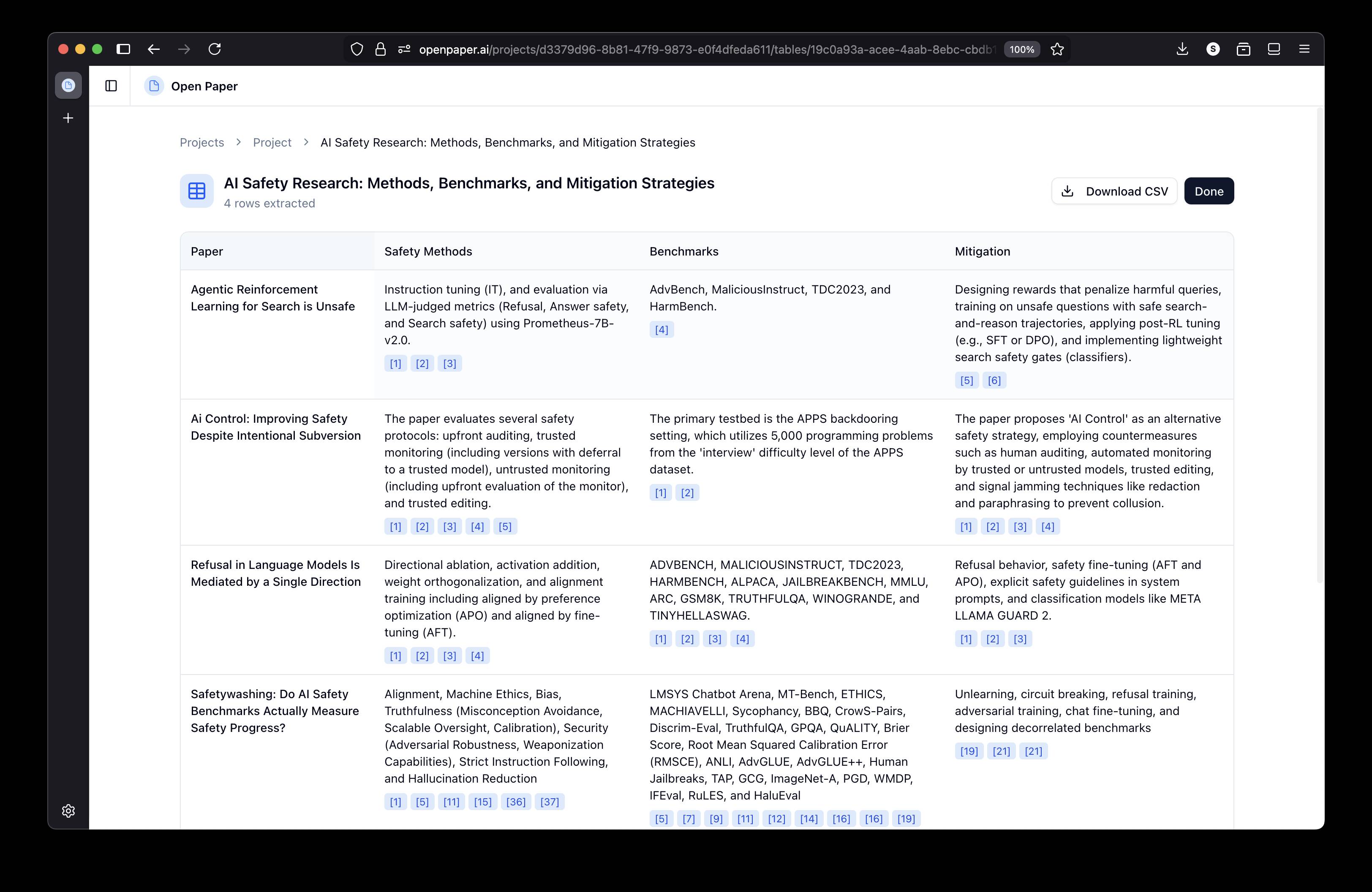
Data tables transform how you move from consuming research to producing it. Instead of scattered insights, you create structured, searchable tables that capture exactly what you need across multiple papers.
Here's how it works:
Define Your Schema Start by telling the AI what you want to extract. "Sample size, methodology, effect size, key finding"—whatever fields matter for your research. The system then analyzes each paper in your project and fills in the gaps.
Get Structured Results The AI reads through your papers and populates a clean table with:
- The values you requested (sample sizes, methodologies, outcomes)
- Direct citations back to the source text
- Paper titles and links for easy reference
Export and Build Download your data table as CSV, or keep it within Open Paper where every cell links back to its original source. Your evidence is now ready for literature reviews, meta-analyses, or systematic reviews.
From Chaos to Clarity
Consider researching COVID-19 vaccine efficacy studies. Instead of:
- Hunting through 12 papers for sample sizes
- Trying to remember which study used which methodology
- Manually compiling efficacy rates
You create an data table with fields like "Study Size," "Vaccine Type," "Efficacy Rate," and "Key Limitations." The AI fills in the table, and you now have:
- Clear comparisons across studies
- Citations for every data point
- A structured foundation for your analysis
Built for Research Workflows
Data tables aren't just spreadsheets—they're research tools designed specifically for academic work:
Precise Field Definitions Be specific with your field names. "Sample Size (n)" works better than "Size." "Primary Endpoint" is clearer than "Result." The more precise your schema, the better the extraction.
Citation Integrity Every data point includes direct citations back to the original paper text. Click any citation to jump directly to the source material, ensuring you can verify and dive deeper when needed.
Project-Based Organization Data tables work within your existing project structure. They understand the papers you're working with and maintain context about your research focus.
Beyond Systematic Reviews
While data tables are perfect for systematic reviews and meta-analyses, they serve many research needs:
- Literature reviews: Extract key arguments and evidence across theoretical frameworks
- Methodology papers: Compare experimental approaches and parameters
- Grant proposals: Compile supporting evidence from preliminary studies
- Teaching: Create structured comparisons for students
- Personal knowledge: Track developments in your field over time
The Research That Moves Forward
By bridging the gap between reading and writing, data tables eliminate one of the most frustrating bottlenecks in academic research. They transform scattered insights into structured evidence that travels with you through your entire research process.
No more lost statistics. No more forgotten quotes. No more recreating wheels when you write.
Just clean, citable evidence that supports your thinking, rather than distracts from it.
Ready to turn your paper collection into structured insights? Start a new project in Open Paper and create your first data table. Your future writing-self will thank you.